Archive

Posts Tagged ‘training’

Here’s what you missed in 2012 (LonVMUG)

December 3rd, 2012 No comments

It’s that time of year when I book the next London VMUG session into my calendar and rather than my usual ‘here’s the agenda, you should go‘ blogpost I thought I’d recap what the last year has delivered. If this doesn’t convince you that there’s value in attending a free event where you could have learnt all the topics listed below as well as networking with your peers then nothing will. :-)

If there’s a topic you’d like covered or if you’d like to present something yourself get in touch with the organising commmittee. I’m planning to present at one of next year’s VMUG sessions (it’s about time!) because it’s a user group and real world experience can be gold dust for others to learn from. I’m told we’re a friendly audience!

Before you continue, register for the next session on 24th Jan 2013!

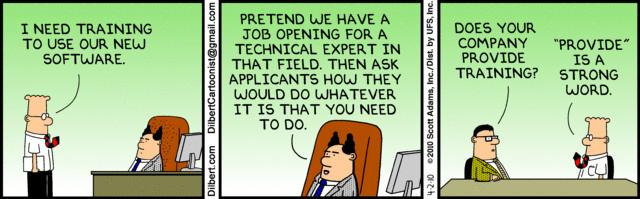
Cartoon showing Dilbert

I’ve grouped them according to some industry trends so your own ‘pointy haired boss’ will also see the value;

I could mention the giveaways (iPad, Fusion-IO card, t-shirts, AppleTV etc) and the free beers afterwards, the fact we had at least five VCDX’s presenting and the live labs from EMC, VMTurbo, and Embotics etc but you’re already sold right?

Register for the next session on 24th Jan 2013 (did I mention it’s free?)

Categories: VMware Tags: , ,

Online virtualisation labs come of age

September 20th, 2012 5 comments

With the launch of the new vCloud Suite along with new VMware certification tracks there’s no shortage of technologies to learn so I’ve been building up my home lab in anticipation of some long hours burning the midnight oil. While doing this I’ve been mulling over a simple (I thought) question;

Why buy hardware to build home labs? Can’t we use ‘the cloud’ for our lab requirements?

I spent a while investigating the current marketplace and while some areas are well covered some are just getting started.

A typical IT ‘stack’

As an infrastructure guy I’m interested in the lower half of the IT stack, principally from the hypervisor downwards (I expect that some infrastructure professionals will need to focus on the top part of the stack in the future, but that’s a different post). There are a plenty of cloud services where you can quickly spin up traditional guest OS or application instances (any IaaS/PaaS/SaaS provider, for example Turnkey Linux do some great OSS stuff) but a more limited number that let you provision the lower half of the stack in a virtual lab;

  • At the network layer Cisco’s learning labs offer cloud labs tailored to the Cisco exams (primarily CCNA and CCNP) and are sold as bundles of time per certification track. In October last year Juniper launched the Junosphere Labs, an online environment that you can use for testing or training.
  • For storage EMC provide labs and this year their internal E-Lab is going virtual and a private cloud is in the works (thanks to vSpecialist Burak Uysal for the info). Scott Drummunds has a great post illustrating what these labs offer – it’s pretty impressive (and includes some VMware functionality). These labs let partners test and learn the EMC product portfolio by setting up ‘virtual’ storage arrays and is something that you’d probably struggle to do in most labs. Other storage vendors such as Netapp offer virtual storage appliances (or simulators) but you’ll need to use a separate IaaS service to run them – there’s no public cloud offering.
  • At the hypervisor layer (although more application and guest OS focused) there’s Microsoft’s Technet labs. These have been available for years and for free (are you listening VMware? :-) ) and let you play with many of Microsoft’s applications, including Hyper-V, in a live, online lab (Vladan has a good article here, and you can try Windows 2012 labs too). At the latest TechEd2012 conference the labs were made available online for two months afterwards and they were also available at the recent Microsoft Management Summit. As Hyper-V can virtualise itself but can’t run nested VMs the labs are limited to looking at the Hyper-V configuration. I tried these labs and was very impressed – they’re free, easy and quick to use (even if they do require IE).
  • According to this post on Linked-In, HP are also looking at the option of publicly available virtual labs although I couldn’t find any information on what they’ll include.

While not strictly cloud labs (depending on your definition of a cloud service) you could rent space and/or infrastructure in someone else’s datacenter – recently I’ve seen companies start to specialize in offering prebuilt ‘lab’ environments which you can rent for training/testing purposes;

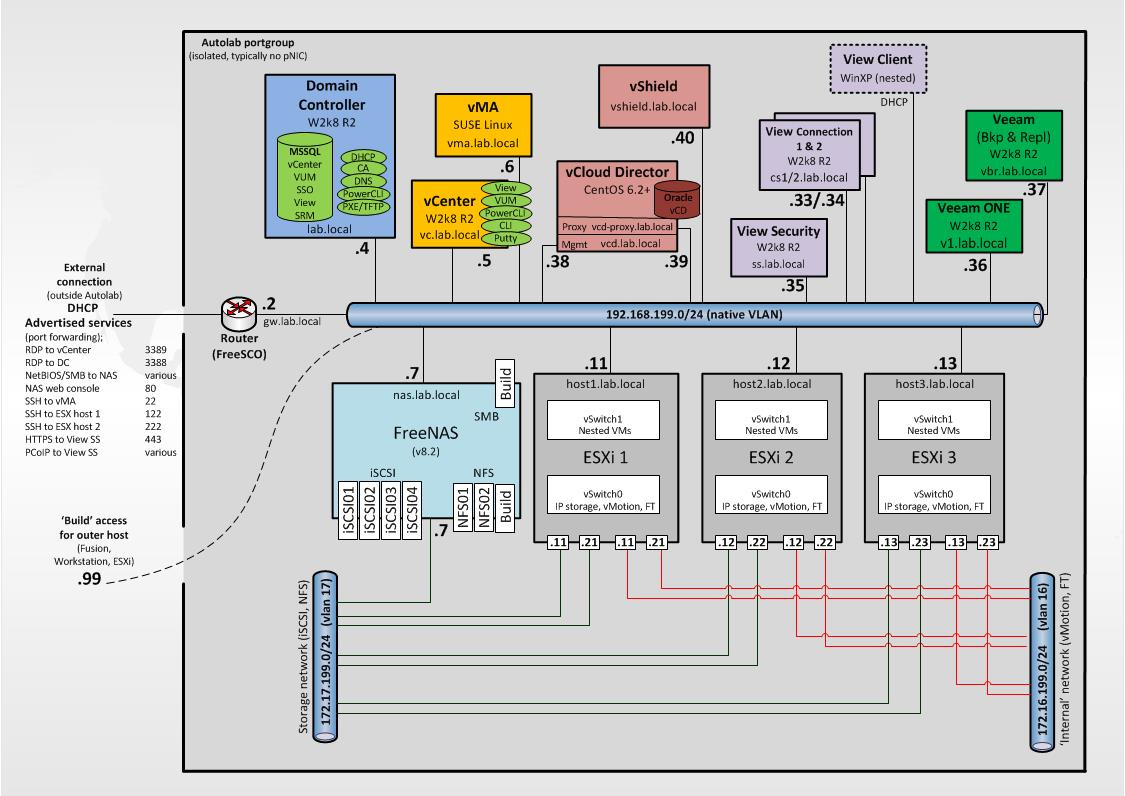
Many large companies will have their own lab facilities and some global companies might offer them internally via private clouds but until recently there were no public cloud services which let you experiment with the hypervisor layer. The well known blogger David Davis had similar thoughts last year and investigated cloud providers who provide ESXi as a VM and was unable to find any. There’s no technical reason why not – vSphere has been able to virtualise itself and run nested VMs for years and although performance might suffer that’s often a secondary concern for a lab environment. It’s also not officially supported but if it’s for training and test/dev rather than production is that a barrier?

Read more…

VCAP-DCD Design workshop – my thoughts

March 30th, 2012 1 comment

After a course postponement in January (due to lack of attendees) I finally took the VMware Design Workshop (v5) this week, a three day course designed to help you prepare for the VCAP-DCD exam as well as real life solution design using VMware vSphere. If you’ve sat the v4 course there’s very little difference so you can probably stop reading now…

I’ve been responsible for the same vSphere implementation at my company for well over four years now, so unlike contractors or consultants I’m not seeing new infrastructures every week and I’m not redesigning mine week to week either. So why go on the workshop you ask? I hoped that spending some time away from the office thinking about design might allow me a fresh look at how we currently have our environment configured as well as giving me a gauge on my own skillset. There was a select group of four on the course which was a slight shame as I think more people would have increased discussions and added value (everyone does things differently and has different circumstances). Despite the limited numbers we had diverse opinions and experience covering government, army, SME and enterprise environments. Luckily our instructor Paul McSharry (@pmcsharry) is one of those trainers who’s also still consulting/contracting so he was more than able to fill any gaps with real world experience including some great discussions around VMware’s vCloud in particular (although neither vCD nor vCloud are on the blueprint they made for great examples). I’ve was lucky to have Mike Laverick for my ICM course back in 2007 and equally lucky to have Paul, he’s a great trainer.

The workshop is still a three day course with minimal hands on work – it’s all whiteboards and discussions. That in itself is quite refreshing as many courses are ‘heads down’ in a PC racing through labs whereas this course is more social. It also meant I kept my mind off work for the three days as I didn’t have a PC in front of me as a distraction! It looks as if the order of the modules has changed from the v4 course but the content is largely the same;

  • Day one – Course introduction, the design process, and storage design
  • Day two – Network design, host (compute) design, and virtual machine design
  • Day three – Virtual datacenter design, management and monitoring design

I was surprised to see some topics which I expected to be ‘bread and butter’ subjects get minor coverage;

  • The section on storage design didn’t cover RAID to any degree and simply states ‘For the majority of VM workloads the RAID level does not matter for performance if the array has sufficient battery-backed cache’ along with ‘Select RAID level based on availability requirements’. As a Netapp guy I agree it generally doesn’t matter – large numbers of spindles are put into aggregates anyway rather than the older RAID group per LUN philosophy of low end MSA arrays etc. The lab exercises didn’t include any IOps, latency or throughput figures either but as Paul rightly pointed out that could overcomplicate the design process given the time constraints, plus it’s a vSphere design course not a specialised storage design.
  • The host design section did cover cluster scale up vs scale out but briefly (given the column inches on blogposts!). Without going into vendor specific detail this topic is rather tricky as many companies will have standards to adhere to, preferred choices (personal or corporate) and extra constraints. That’s exactly what the course states – organisational constraints are most likely what you’ll have to contend with.
  • There is a single page on licensing which simply states ‘buy the license version that supports the features required in your design’. Thanks for that, great way to gloss over the controversial vRAM!
  • I also expected a heavy focus on the new features of v5 (Autodeploy, Storage DRS etc) but while they were covered it wasn’t in depth. On reflection that’s probably correct as there are so many things to consider for the average design that the basics are still the same.

Every vendor course has some ‘best practices’ which you take with a pinch of salt and this course is no different. ‘Always use jumbo frames’, ‘Always buy the fastest CPU you can afford’, ‘Prefer distributed switches’. Keep your questioning hat on!

The lab scenarios didn’t always give enough information but that does at least make them flexible – there’s no reason why you can’t set yourself some constraints. There was no requirement around storage protocol choice for example so I found myself picking NFS but having to justify it based on other elements of the design. Cost wasn’t mentioned in mine beyond ‘it should be cost effective’ so you have to make you own mind up – would vCSHB be worthwhile for example? I decided not and as long as you understand the implications of your choices you’ve achieved your goal.

Overall I found the course very useful although given that I’m not doing design as part of my job I suspect I’ll find the exam very tough. The blogosphere covers a lot of relevant material which the course skims over due to time restrictions – I doubt the workshop alone would be sufficient to pass the exam. Now I just have to hit the whitepapers and the design bible (VMware vSphere design by Forbes Guthrie, Scott Lowe, and Maish Saidel-Keesing) while I wait for the v5 exam to be officially released. Given that the beta has already come and gone I don’t think I’ll have long to wait!

UPDATE May 2012 – The exam has now been released. You can get details on the official VMware Education page and sign up for authorisation here.

Further Reading

Sean Crookston has a collection of links from other workshop reviews.

The VCAP-DCD forums

VCAP-DCA and it’s value to me

May 28th, 2011 6 comments

After several months of study (slightly longer than planned due to writing up all my study notes) I was finally notified that I’d passed the VCAP-DCA exam yesterday. Hurrah!

The VCAP-DCA blueprint is pretty comprehensive and for many will involve studying topics they’ve not used before. Regarding the exam itself I have nothing of value to add that hasn’t already been said, but it’s been nice to reflect on what I gained from taking the certification. Given that quite a few recruiters simply state ‘VCP/VCAP/VCDX’ as general requirements for job specs I’m not sure how much value the certification holds in the marketplace yet, but here are the top five ‘wins’ for me as a result of studying;

  1. PowerCLI. I’ve scripted in many languages over the years but none that are so easy to pick up and achieve results with. I’ve used PowerCLI in production to automate deployments, get weekly reports and automate some compliance work and I doubt I’d have done so much if I didn’t have to cover the VCAP-DCA blueprint (especially the VIX component).
  2. Distributed switches – my company don’t have Enterprise+ licencing so I don’t get to work with these in a production environment. Lab testing is never the same and the exam highlighted a few areas where I could improve. I like the concept, but with under a hundred hosts I’m not yet convinced of the value for money. Various features and products (vCD comes to mind) are dependant on vDS, so I think it’ll get pushed more and more by VMware however.
  3. Host profiles – again, I had no real world experience due to licencing restrictions.I did learn that they’re not that great though, even in limited lab testing. There are too many things they can’d do, a fairly limited interface and lack of flexibility. Definitely not the equivalent of Group Policy in an AD environment (which was my mental equivalent).
  4. ESXTOP. I’ve always been somewhat wary of this, especially after a presentation at the LonVMUG which was very good but hurt my brain! Despite being a Linux admin so comfortable with command line, something about the advanced ESXTOP settings seemed complex and hard to understand. After watching some VMworld sessions and working through the ESXTOP bible it’s now much clearer and I’ve found myself using it far more at work.
  5. vCenter Heartbeat. Like many places we’re increasingly reliant on vCenter and I worry about resilience. I now  know how to use it – and the fact that I probably wouldn’t.

vcap4-dcaAs with any exam though there are questions which you might not know the answer to, but you know a quick Google would tell you the answer (so have little real value in the exam, in my opinion). These aren’t quite in that category, but here’s three things which I had to learn purely for the sake of the exam;

  1. Orchestrator. Much though I love automation this isn’t easy enough to use and the reliance on Javascript instead of PowerCLI is a deal breaker for me. I can write Javascript (or use Onyx) but for an admin this is hard to use compared to PowerCLI.
  2. Fault Tolerance. Due to the 1vCPU restriction I’ve not got any servers which really benefit from this, so it was an exercise (if interesting) in theory only.
  3. vShield Zones. I’d actually hoped this might be in my top five, but in the end it’s in my bottom three. The interface is incredibly basic compared to any dedicated firewall so I wouldn’t want to use it in production. The exam also only covers v1.0, whereas v4.0 is the current release.

I used a wide variety of study materials, and in order of most beneficial here’s how I’d list them;

  • Blogs – these complement the official docs – it’s where people spot the real challenge of a particular feature, or the unspoken gaps not mentioned in the official docs. Start at vLaunchPad.
  • Official documentation
  • VMworld sessions – free to view (mostly) and focused on particular subjects, these an are often overlooked treasure trove.
  • Study notes – creating my own study notes definately helped me remember things, as did other people’s (Sean Crookston’s especially).
  • Community forums – both the general vSphere ones and the VCAP-DCA forum are useful places to post questions, and see what everyone else is asking. vicfg-firewall anyone?
  • Trainsignal’s Troubleshooting training course by David Davis. The information is very useful and goes above and beyond the blueprint requirements.

And of course I have something to add to the C.V.!